Memory per client
Every client gets its own brand voice and memory.
Per client, Clyde remembers the brand voice, the audience, the goals and what you agreed, and keeps writing with it. One client's memory is kept apart from another's.
- Per client
- Five fixed blocks plus the memories
- Updated
- Every night
- Kept
- As long as your subscription runs
This is what one client's memory looks like.
Per client, five fixed blocks that always come along, plus the memories Clyde records along the way. You can edit every block yourself.
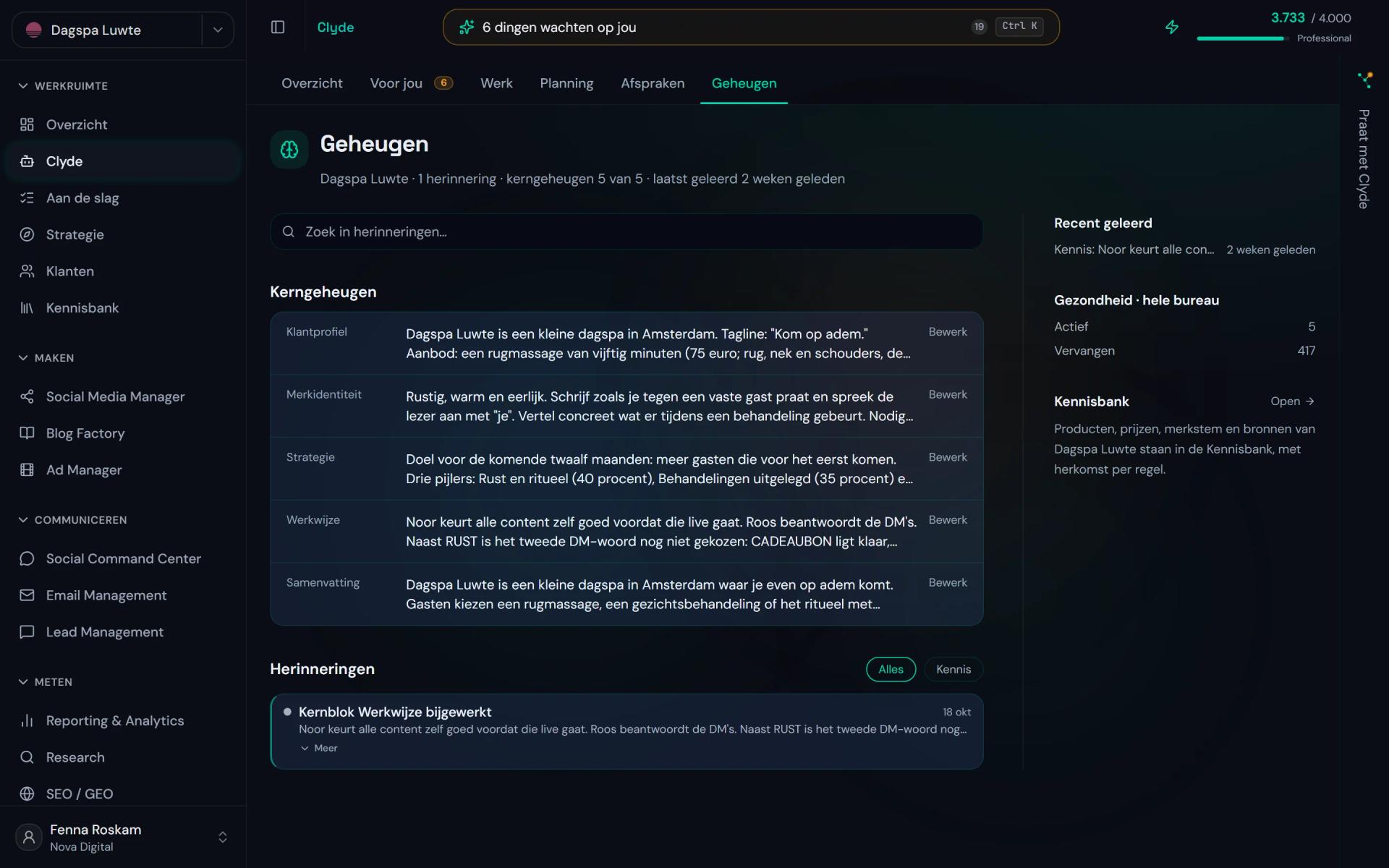
Four sources, per client.
When Clyde writes something for a client, he draws on four sources. You see and edit the core memory and the strategy yourself in the app.
Who the brand is
The client profile, the brand voice, the audience and what is and isn't allowed. This always comes along, and your corrections go into it.
Strategy and research
The goals from the strategy session, the pillars and the research into market, competitors and audience. Clyde tests his proposals against them.
Memories
Clyde records what you agree and what you correct. What matters weighs more; old, unimportant details weigh less.
The conversation
The ongoing conversation and the screen you are on. On a client's page, Clyde knows which client you mean.
Setting the tone of voice per client.
The brand voice sits per client in the core memory: how the client sounds, which words fit and which never do. So every client brand sounds like itself, even when you serve ten clients at once.
Brand identity · Dagspa Luwte
Calm, warm and honest. Write the way you talk to a regular guest and address the reader informally. Say concretely what happens during a treatment. Invite, never push. No promises about skin or results, no discounts, no urgency language such as "while stocks last" or "now or never", and no jargon without explanation.
Separate per client, updated every night.
So a brand voice does not carry over to another client, and Clyde does not get buried under old details.
Separate
Every client has its own memory
Each client has its own workspace with its own memory. When Clyde works for client A, he retrieves client A's memory, not client B's. Technically, every memory about a client is tied to that agency and that client in the database, and every retrieval filters on them.
Every night
The summary per client updated
Every night, Clyde updates the summary for each client; old, unimportant details weigh less after that. Clyde keeps the memory and the conversations for as long as your subscription runs.
The difference with ChatGPT projects.
ChatGPT remembers what you put in a project, also when you share that project with your team. Clyde has one memory per client, tied to that client's calendar, approvals and report, and your client follows along in their own environment.
ChatGPT projects
Memory per project
You set the brand voice and context yourself in every project. A content calendar, your client's approval and publishing are not in OpenAI's description; you handle those in other tools.
Clyde
Memory per client
Tied to that client's calendar, approvals and report. Your client approves and follows along themselves.
Source: Projects in ChatGPT, checked on 7 November 2026
The first month and after.
The difference between a generic AI and a colleague who knows your clients grows with every correction.
Month 1
Clyde gets to know your clients
Clyde follows the brand guidelines, but not yet with the nuance you want. You correct a lot, and he takes those corrections on board.
After that
Less steering
Clyde knows a client's habits: which words to use and avoid, how a post opens, what you agreed. How much he may do on his own, you decide per task.
Questions about memory.
What agencies want to know before they hand their clients to Clyde.
Does one client's brand voice leak into another's?
No. Each client has its own memory, and every retrieval filters on the agency and the client. When Clyde works for client A, he does not retrieve client B's memory.
What exactly does Clyde remember?
Per client: the client profile, the brand identity, the strategy, the way of working and a summary. On top of that come the memories from your conversations and corrections.
How long until Clyde knows a client?
The basis is in place after the brand scan in week 1. In week 3 you tune the brand voice together, up to three rounds per brand. The nuance comes in the first month, with your corrections.
How long does Clyde keep the memory?
Clyde keeps the memory and the conversations for as long as your subscription runs. After you cancel, we send you an export of your data within 30 days; after that we delete your workspaces.
Where is the memory stored?
In a database at Supabase in Frankfurt. The language model runs at Anthropic and OpenAI in the US and only receives the context the task needs. Everything about where your data is stored is on the trust page.
Ready for a colleague who knows your clients?
A 30-minute conversation. After it, you know whether Clyde fits your clients.